Centre for Applied Behavioural Research
Note: Section Y-9 is a fictional wartime research organisation created for the Rhys Maren series.
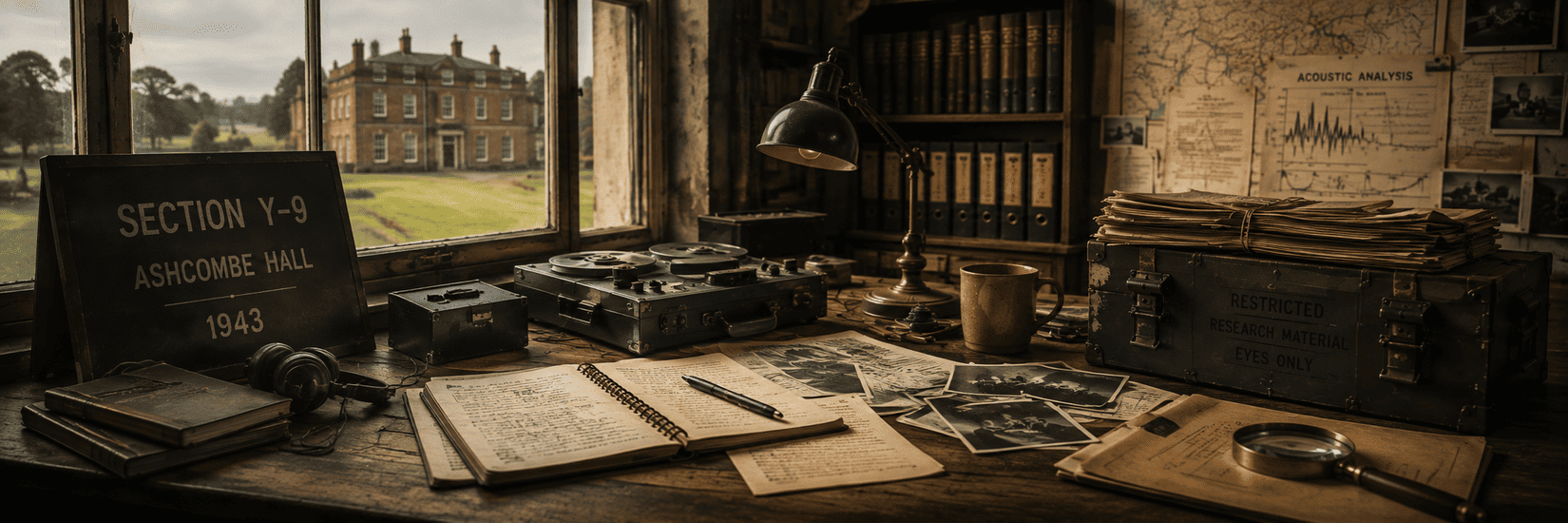
Section Y-9 was a small, highly classified wartime research unit established in 1943 and based at Ashcombe Hall in Cheshire. Officially, the unit did not exist. Staff assigned to the project appeared on ordinary establishment records under unrelated duties, while the work itself was divided so carefully that few of those involved understood its full purpose.
Unlike conventional intelligence units, Section Y-9 was not primarily concerned with intercepting enemy communications or breaking codes. Its interest lay in the human voice and, in particular, in what communication might reveal beyond the words being spoken.
Researchers studied changes in rhythm, hesitation, breathing, emphasis, silence and emotional stress. These observations were considered alongside the speaker's identity, physical condition, relationships, language and known history. The aim was not simply to decide whether someone was telling the truth. Section Y-9 was attempting to understand whether human behaviour left patterns within ordinary communication that could be observed, recorded and compared.
Ashcombe Hall
Section Y-9 operated from Ashcombe Hall, a requisitioned country house overlooking the Cheshire Plain. To most of those working there, the establishment appeared to be conducting specialised wartime psychological and communications research.
The Hall provided both accommodation and working space for a staff of fewer than twenty people. Its basement contained recording rooms adapted from the old cellars, while offices, interview rooms and records occupied parts of the main house.
The small size of the establishment meant that scientists, engineers, translators, Wrens and clerical staff worked in unusually close proximity. Even so, knowledge of the project remained carefully divided. Most people understood their own work but knew little about how it fitted into the larger programme.
The Research
The central question behind Section Y-9 concerned what human communication could reveal beyond the words that were actually spoken.
Recordings were studied repeatedly, with particular attention paid to pauses, changes in pace, breathing, uncertainty and emotional response. Researchers were interested in whether such details changed in recognisable ways when people remembered, concealed, feared or struggled to describe particular experiences.
The project never treated these signs as reliable proof of deception because individual behaviour varied too greatly. A pause might indicate fear, exhaustion, uncertainty or grief, but it might equally have no particular significance.
For this reason, context became increasingly important to the work. A recording without information about the person who made it was considered incomplete. Researchers preserved names, dates, relationships, circumstances, locations and other supporting records wherever possible. Understanding the person became as important as preserving the voice.
This practice eventually produced one of Section Y-9's most important legacies, because the project accumulated an unusually detailed collection of recorded human communication accompanied by extensive information about the people and circumstances behind it.
The People
Section Y-9 brought together specialists who would rarely have worked beside one another under ordinary wartime conditions. Linguists and translators worked alongside psychologists, engineers, mathematicians, archivists and experienced listeners.
Among those attached to the work at Ashcombe Hall were Margaret Maren, Hilde Schmidt and Tomasz Kovács. Their individual roles differed, and none of them appears to have been given a complete understanding of the programme.
The project was supervised by figures including Finch and Graves, whose involvement would later prove considerably harder to trace in surviving records.
After the War
The end of the Second World War left Section Y-9 in an uncertain position. Its immediate wartime purpose had disappeared, but the project had accumulated a substantial archive, developed methods considered worthy of further study and assembled a group of people with unusually specialised experience.
The work was therefore not immediately abandoned. Recordings were boxed and transferred, research continued and the project gradually moved away from the temporary wartime organisation that had created it.
In 1947, Section Y-9 ceased to exist under that name, and its work, methods and surviving archive passed to a newly created civilian organisation called the Centre for Applied Behavioural Research.