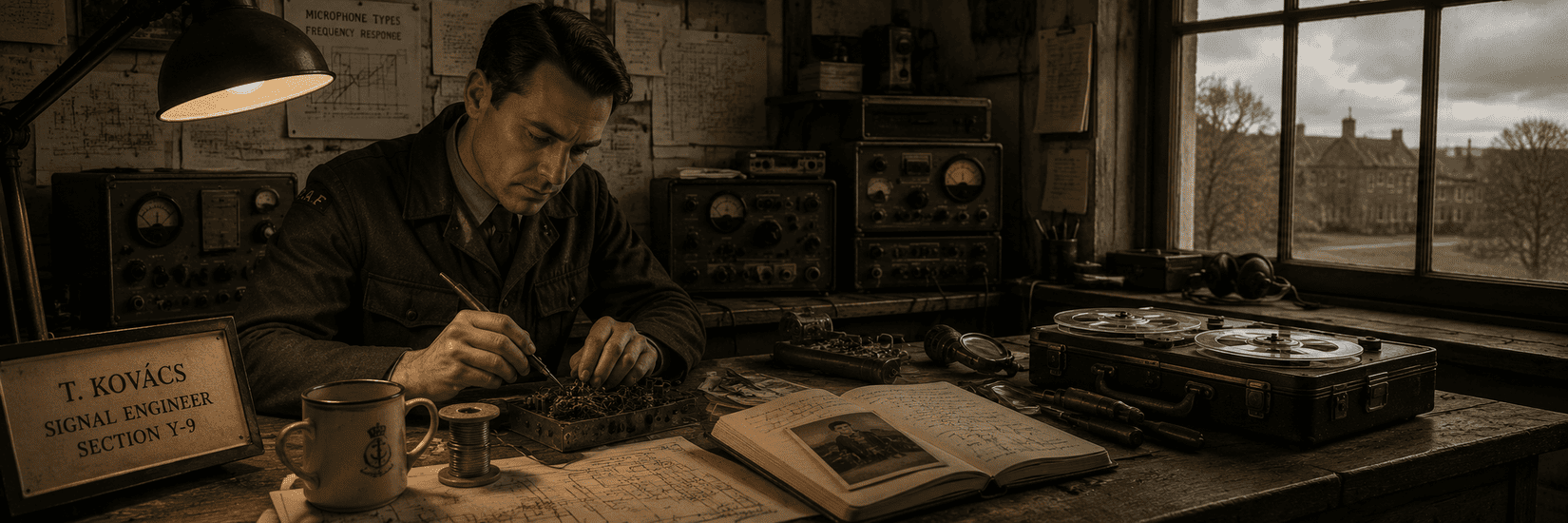
Tomasz Kovács
Tomasz was born in Warsaw to a Polish father and a Hungarian mother, growing up in a household where changing languages several times during a meal was entirely ordinary. From an early age he developed an instinctive understanding of communication, not simply what people said, but how meaning changed with accent, timing and context. Mathematics came naturally to him, as did engineering, and by the time war engulfed Europe he had already shown an unusual ability to solve practical technical problems.
After escaping occupied Poland through military evacuation routes, he eventually reached Britain and joined the RAF. His aptitude for radio systems, recording equipment and signal engineering quickly brought him into specialist wartime work, where reliable recording and accurate interpretation of communications were becoming increasingly important. By the closing years of the war he had become one of the small number of engineers trusted to develop and maintain the recording systems used by Section Y-9.
Unlike many of the researchers around him, Tomasz was not interested in psychology for its own sake. His fascination lay in fidelity. He believed that the value of any recording depended upon how faithfully it preserved the original conversation. Every improvement in microphones, recording equipment or synchronisation was, to him, another step towards capturing human communication without altering it. He cared as much about documenting who was speaking, where they were, why the conversation took place and how it had been recorded as he did about the recording itself. Long before the term became fashionable, Tomasz regarded provenance as inseparable from evidence.
When Section Y-9 evolved into the Centre for Applied Behavioural Research, Tomasz remained. Over the next fourteen years he watched the organisation change from wartime listening to the broader study of human communication. As technology developed, so did his work. Wire recorders gave way to magnetic tape. Audio was joined by moving images. Experimental video recording, synchronised sound and the technical challenges of preserving complete conversations gradually became his responsibility. He never saw these developments as separate disciplines. They were simply better ways of preserving what people actually did when they communicated.
The work demanded almost complete secrecy. Officially he remained an engineer attached to a succession of obscure government departments. In reality his professional life disappeared behind security classifications, administrative reorganisations and projects that could never be discussed outside the workplace. Weeks away from home, cancelled leave and unexplained absences became an accepted part of family life. Hilde eventually stopped asking where he had been because she knew the question could never receive an honest answer.
When CABR finally closed in 1963, Tomasz returned to civilian life carrying a reputation for meticulous engineering but very little that could be described publicly. He was not embittered by the years he had given the organisation, but he understood that they had cost him something no career could replace. Much of his children's early lives had passed while he had been preserving the conversations of strangers.
In later life he developed an almost obsessive habit of recording ordinary family occasions. Birthdays, meals, conversations around the kitchen table and visits from old friends were quietly documented, dated and carefully labelled. To everyone else it seemed an eccentric hobby. To Tomasz it was simply the continuation of a belief that had guided his entire working life: that the smallest details of ordinary human conversation were often the first things history allowed itself to lose.
When he eventually adopted the family surname, Schmidt, it was done without ceremony. It reflected neither politics nor convenience. It simply acknowledged that the man who had left Poland before the war no longer existed in quite the same form. His family had become his only permanent identity, and sharing their name felt more truthful than continuing to carry one that belonged to a life he could never return to.