Station Trefor
Note: Station Trefor is a fictional location. It does not exist in or near the real North Wales.
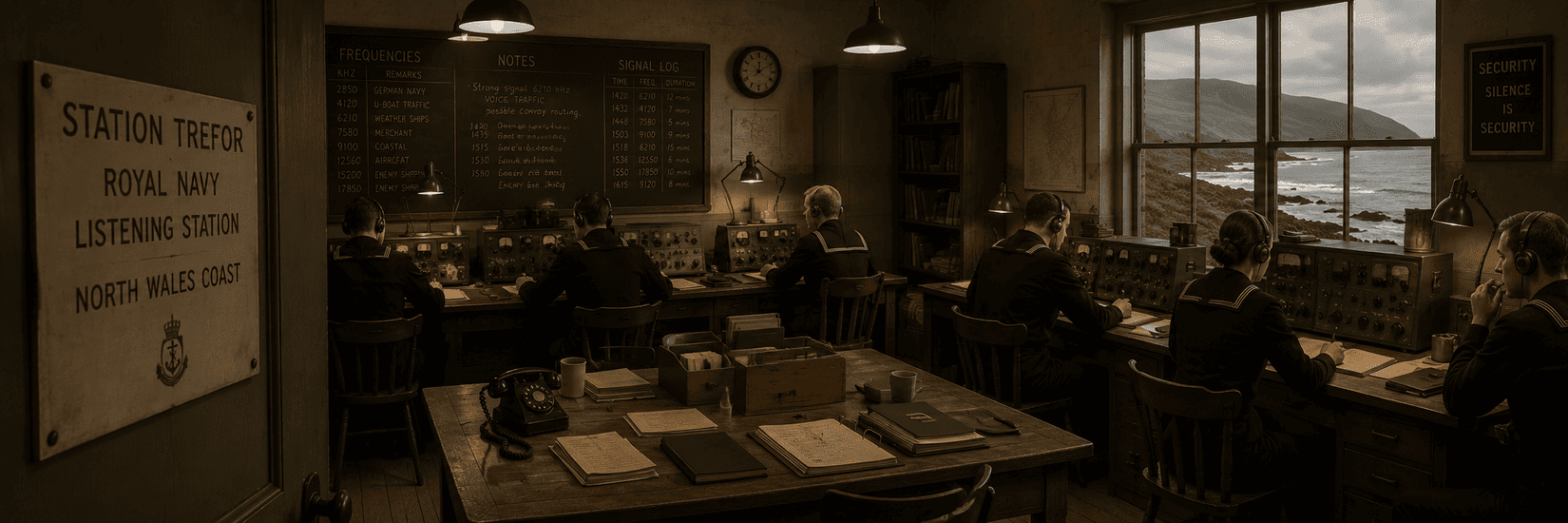
Station Trefor was a small Royal Navy listening station established on the North Wales coast during the Second World War. Officially it existed to monitor and analyse intercepted radio traffic, but much of its work remained classified for decades and little was ever recorded publicly.
Unlike the larger Y Stations scattered across Britain, Station Trefor operated with a small, close-knit team of naval personnel, linguists, engineers and civilian specialists. Working from an isolated coastal site, they listened to thousands of hours of intercepted transmissions, searching not only for military intelligence but for patterns that others overlooked. Their work demanded patience, extraordinary concentration and an ability to recognise meaning hidden within fragments of speech.
The station developed a reputation for attracting people with unusual talents for listening. Operators often spent entire shifts analysing damaged recordings, weak transmissions and voices buried beneath static. While most of the material proved routine, a small number of recordings resisted every conventional explanation. Official reports described them only as "anomalous acoustic phenomena", a phrase that revealed almost nothing while encouraging endless speculation among those who had worked there.
After the war, Station Trefor was quietly decommissioned. Most records were dispersed between government departments or destroyed under routine security procedures, leaving only scattered references in surviving archives. Former staff rarely discussed their work, even with their families, and many official files remain heavily redacted.
In Archives of Ash, Station Trefor forms part of the hidden history behind Rhys Maren's investigation. What began as an ordinary wartime listening station may have been involved in something far more significant: an attempt to understand whether human voices can preserve more than words alone, and whether memory itself can become part of the evidence.
Today, little remains beyond weathered concrete, forgotten paperwork and a handful of unanswered questions. Like so much of Britain's wartime infrastructure, the station has largely disappeared from public memory, leaving only faint traces for those willing to look closely.