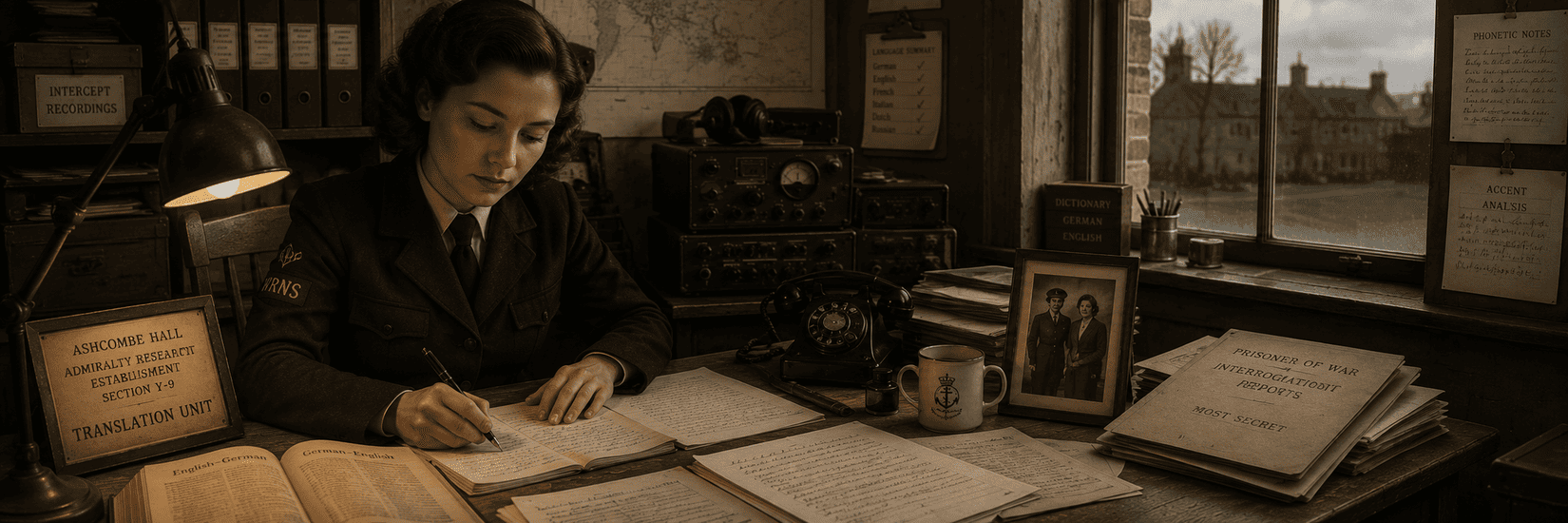
Hilde Schmidt (1921–2008)
Hilde grew up near Hamburg in a family of teachers. She had an exceptional ear for languages and by the outbreak of the war spoke fluent German, English and French. She never joined the Nazi Party and never showed any enthusiasm for the regime, but like millions of ordinary Germans she found herself living inside it.
During the later years of the war she was attached to a military translation unit. When Allied forces advanced she was captured, questioned and eventually transferred to Britain. Her command of English, together with an unusual ability to distinguish regional accents and dialects, made her useful at Ashcombe Hall.
Officially she remained a prisoner of war. In practice she became one of the people the listeners depended upon.
At Ashcombe Hall, Hilde became far more than a translator. Working alongside British personnel, she helped interpret intercepted material while sharing in the secret work that took place inside the listening station. Removed from the conflict that had brought her there, she formed an unlikely friendship with Margaret Maren. The two women spoke about their families, their homes and the war they both wanted to see end, finding common humanity despite standing on opposite sides of the conflict.
Margaret's diary records Hilde as one of the few people with whom she could speak honestly. During moments of fear, grief and uncertainty, Hilde offered quiet support without judgement, often understanding what Margaret could not bring herself to say aloud. Their friendship became one of the emotional anchors of Margaret's wartime life.
After the war, Hilde disappeared almost completely from the official record. Her personnel file contains no indication of where she went after her release, no forwarding address and no account of the life she built beyond Ashcombe Hall. Only a surviving letter to Margaret confirms that their friendship continued after the war and that both women carried the burden of what they had witnessed in silence for many years.
Decades later, Hilde's records, letters and Margaret's diary become key pieces of evidence in Rhys Maren's investigation into Ashcombe Hall. Together they reveal that history is often preserved not in official files, but in the relationships, memories and quiet acts of kindness that survive long after the records fall silent.