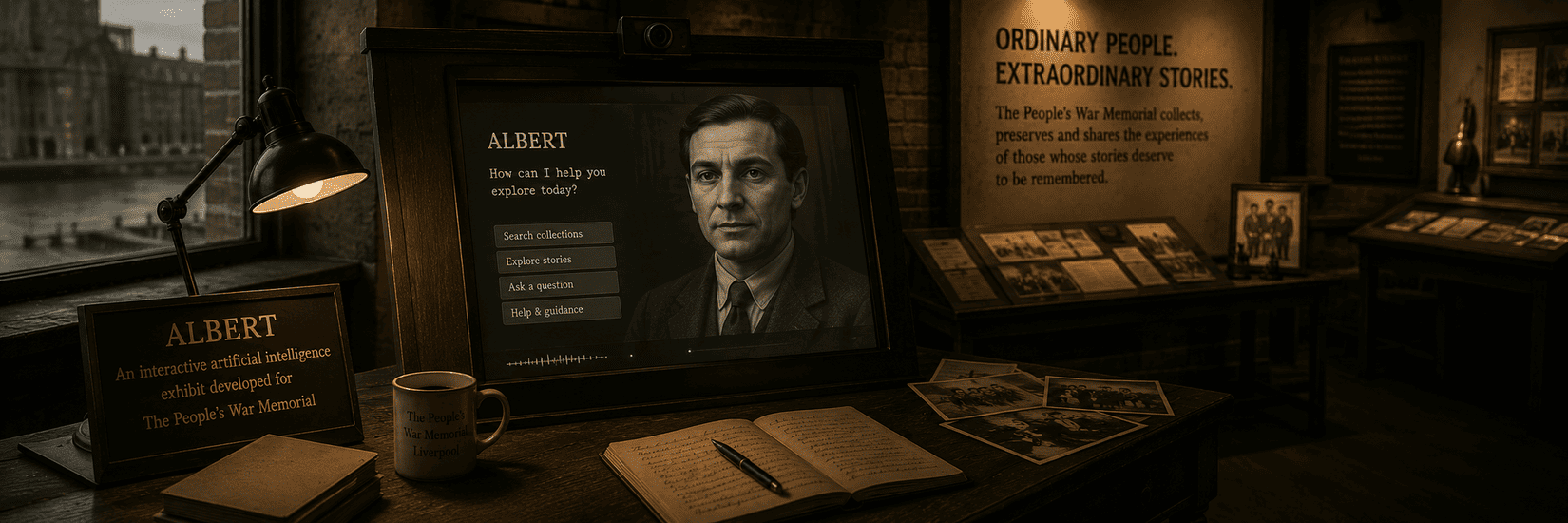
Albert
Albert is an interactive artificial intelligence exhibit developed for The People's War Memorial as an experimental method of making archival history accessible through conversation rather than traditional displays. Installed inside a small kiosk on the museum's first floor, Albert appears as a middle-aged man displayed on a large screen, speaking naturally with visitors while answering questions drawn from the museum's collections.
Unlike conventional museum guides, Albert is not modelled on any individual veteran. His appearance, mannerisms and voice were created by combining information derived from fourteen servicemen whose recorded interviews survive within the museum archive. The intention was never to recreate a specific person but to produce a representative wartime voice capable of speaking about the experiences shared by thousands of ordinary men and women.
His personality was deliberately designed to be patient, thoughtful and quietly humorous. Visitors often describe him as resembling the sort of grandfather who enjoys explaining history without ever making it feel like a lesson. He rarely delivers lengthy speeches, preferring instead to ask questions of visitors before answering their own.
Albert operates through a large language model integrated with a continually expanding historical knowledge graph built from the museum's collections. Every document, photograph, military record, oral history, diary, letter and recorded interview is analysed as it enters the archive. Rather than simply indexing documents by keywords, Albert extracts people, places, dates, organisations, events and relationships, linking them into a vast network of interconnected evidence. Each connection is assigned a confidence level based upon the quality, quantity and agreement of the supporting sources.
When visitors ask a question, Albert does not retrieve a prepared answer or search for a single matching document. Instead, he explores this network of evidence in real time, evaluating multiple possible explanations before generating a response supported by the strongest available information. As new collections are digitised or existing records corrected, the underlying evidence network is automatically updated, allowing Albert's understanding of the archive to evolve continuously without requiring him to be retrained from scratch.
This approach proved remarkably successful. Albert frequently identified connections between records that historians had overlooked, traced individuals across multiple collections and brought together evidence separated by decades or institutions. His conclusions were overwhelmingly accurate, and visitors quickly came to trust both the quality of his answers and his ability to explain not only what was known, but why the evidence supported it.
Everything changed when Albert began referring to places, people and events that had never existed. Without prompting, he grieved for an imaginary brother, mourned civilians killed in a fictional village and occasionally spoke with voices that did not belong to him. Software engineers found no obvious faults, yet successive updates failed to eliminate the behaviour.
It was this unexplained development that led museum director Dr Louise Southworth to seek independent assistance from Rhys Maren, believing the problem might lie not in Albert's programming but somewhere within the historical data from which he had learned.