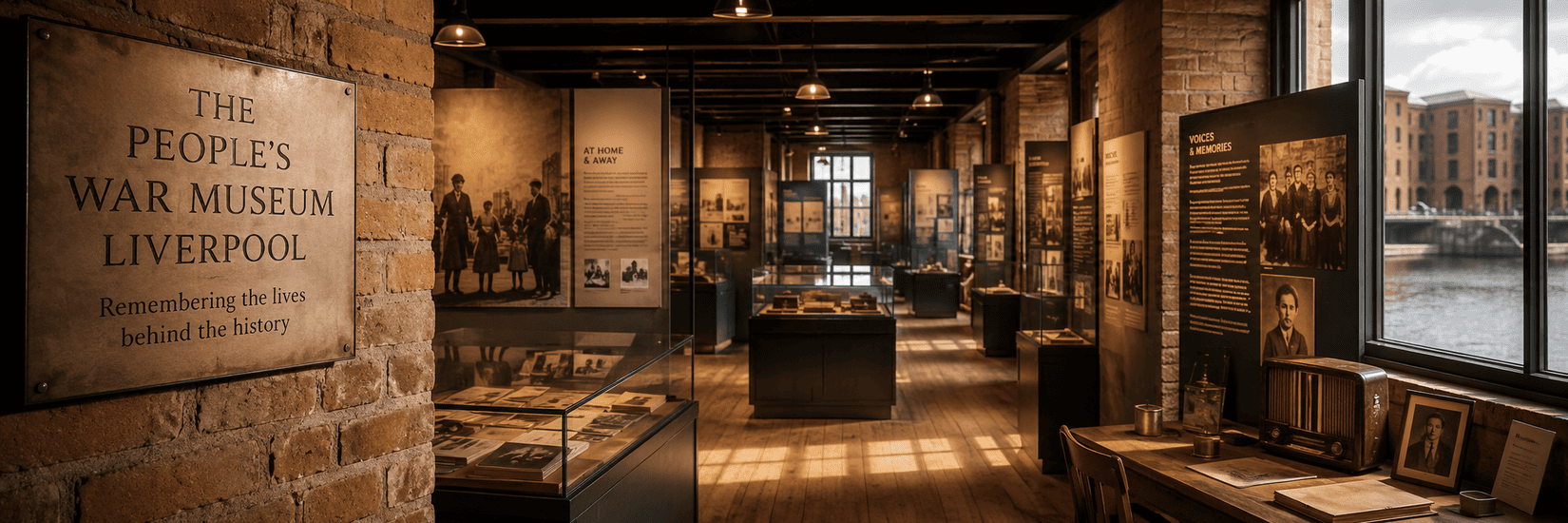
The People's War Memorial
Note: The People's War Memorial is a fictional location. It does not exist in or near the real Liverpool.
The People's War Memorial occupies a restored nineteenth-century warehouse on Liverpool's historic waterfront, a short walk from the Albert Dock and the Mersey. Unlike the city's larger national museums, it was founded with a narrower purpose: to preserve the experiences of ordinary people whose contributions to the Second World War rarely appear in official histories. Its collections focus on civilians, merchant seamen, civil defence workers, wartime industries, refugees, women in uniform, and the countless individuals whose personal stories would otherwise disappear with succeeding generations.
The museum was established during the late 1990s by a small group of local historians, former servicemen and archivists who believed that Britain's wartime history had become increasingly dominated by military campaigns while the everyday experiences of ordinary families were slowly being forgotten. Rather than collecting famous artefacts, they concentrated on diaries, letters, photographs, recorded interviews, ration books, identity cards and personal possessions donated directly by local families.
The building itself retains much of its industrial character. Exposed brickwork, cast-iron columns and timber roof trusses remain visible throughout the galleries, giving visitors the impression that the museum occupies a working dock warehouse rather than a purpose-built exhibition space. Displays are modest, relying more on original material than expensive presentation. Visitors often describe the museum as quiet, personal and reflective rather than spectacular.
The permanent galleries follow wartime life chronologically, beginning with the outbreak of war in 1939 and continuing through evacuation, rationing, the Blitz, military service, merchant shipping, intelligence work, victory and post-war reconstruction. Particular emphasis is placed on Merseyside's role as Britain's principal Atlantic port, the Battle of the Atlantic and the thousands of merchant sailors whose contribution remained largely unrecognised for decades.
One gallery recreates a wartime living room complete with period wireless, blackout curtains and contemporary newspapers. Another explores Liverpool's docks during the Blitz using original photographs, oral history recordings and surviving civil defence equipment. Visitors are encouraged to listen rather than simply observe, reflecting the museum's belief that personal testimony often conveys history more powerfully than objects alone.
The museum maintains an extensive oral history archive containing thousands of recorded interviews with veterans, factory workers, nurses, Wrens, evacuees and civilians. Many were recorded during the 1970s and 1980s when the generation who experienced the war first-hand were beginning to recognise that their memories needed preserving. The archive continues to expand through donations from families and local history organisations.
Although relatively small, the museum enjoys an excellent academic reputation for its archival standards. Universities regularly consult its collections for research into wartime social history, while documentary producers frequently borrow photographs, recordings and original documents. The museum has developed a reputation for careful provenance, preferring to reject uncertain material rather than risk compromising the historical record.
Unlike many larger institutions, The People's War Memorial receives comparatively modest funding. It operates with a small permanent staff supported by volunteers, retired teachers, local historians and military enthusiasts. Financial pressures are constant, and many exhibitions are assembled using donated materials and volunteer expertise rather than expensive commercial installations.
Its best-known exhibit is Albert, an experimental interactive digital guide developed to answer visitors' questions about the Second World War using the museum's extensive archival collections. Albert was created not as a replacement for historians but as a conversational interface capable of introducing visitors to the lives of ordinary people represented within the archive. His unexpected behaviour would later become the catalyst for Rhys Maren's first investigation.
For Rhys Maren, however, the museum is more than another archive.
His first investigation, involving the museum's experimental artificial intelligence guide Albert, uncovered one of the most unusual cases of his career. Since then, the museum has become one of the few places Rhys returns to regularly. Director Dr Lillian Southworth trusts his judgement on difficult questions of evidence and provenance, while Albert has become an invaluable sounding board whenever an investigation reaches a point where history, archives and recorded evidence intersect.
Rather than simply visiting the museum when a case requires it, Rhys has become part of its extended community. He is often consulted about unusual donations, unidentified photographs, disputed documents and family collections whose significance is not immediately obvious. The museum, in turn, provides him with access to one of the finest collections of archival material in Britain and to the expertise of historians, archivists and volunteers who share his belief that careful evidence matters more than quick conclusions.
The relationship is built on a shared philosophy. The museum exists to preserve the lives of ordinary people before they are forgotten. Rhys's investigations pursue exactly the same goal. While others search for famous names or dramatic events, both Rhys and the museum are interested in the quiet evidence that survives in family albums, forgotten recordings, damaged papers and overlooked archives.
Visitors know the museum as a place where history is preserved. Those who know Rhys understand it as the place where many of his investigations truly begin.
Albert remains the museum's best-known exhibit, but for Rhys he is something more than an interactive guide. Their conversations are rarely about finding immediate answers. Instead, Albert challenges assumptions, tests evidence and asks the questions that others overlook. Together with Lillian Southworth, he forms one of the few professional relationships Rhys values enough to seek out even when no investigation has yet begun.