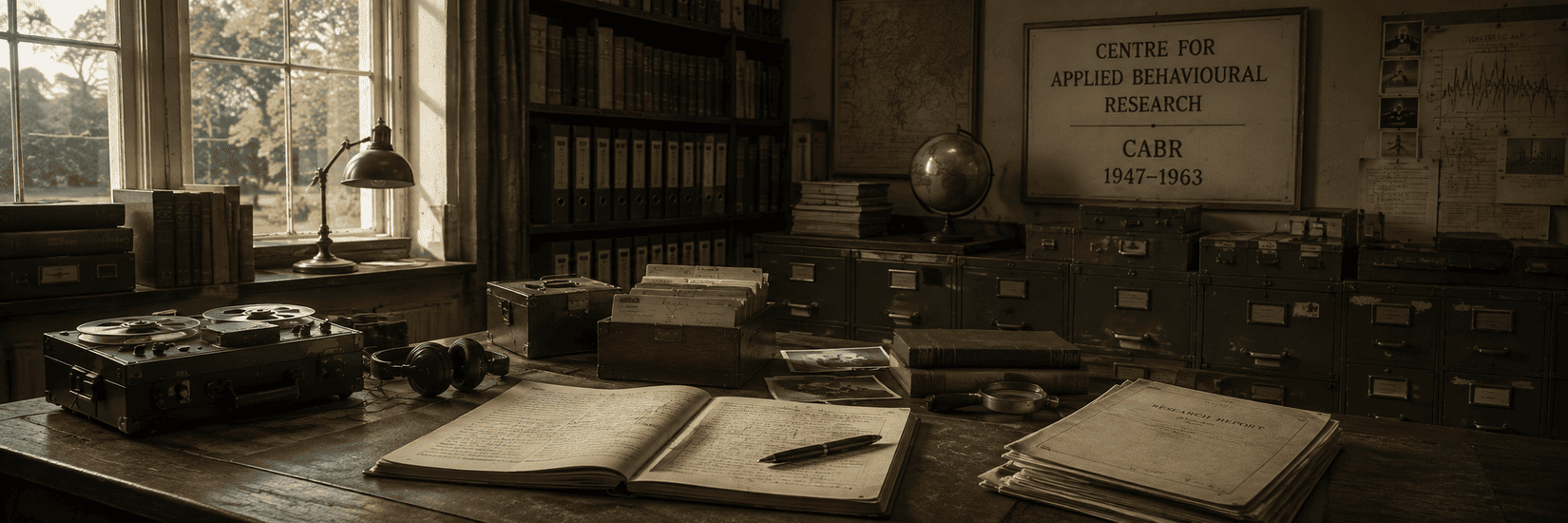
Centre for Applied Behavioural Research
Note: The Centre for Applied Behavioural Research is a fictional research organisation created for the Rhys Maren series.
The Centre for Applied Behavioural Research, usually known as CABR, was a British research organisation established in 1947 as the successor to the wartime Section Y-9 programme.
Its creation allowed work begun at Ashcombe Hall during the Second World War to continue under a civilian organisation. The change of name marked the end of the wartime project, but its central purpose remained largely unchanged.
CABR continued to study how people communicate, remember, recognise one another and respond emotionally under different circumstances. Its researchers remained particularly interested in the parts of communication that existed beyond the words themselves, including rhythm, hesitation, interruption, silence, expression and gesture, as well as the relationship between behaviour and personal experience.
Origins
Section Y-9 had accumulated a substantial collection of recordings during the war and had developed methods for studying communication alongside detailed information about the people being recorded.
When the war ended, the work fitted awkwardly between existing government departments. It touched psychology, communications, intelligence, engineering and emerging forms of computing without belonging comfortably to any one of them.
Rather than dismantle the programme completely, the government transferred its work into a new civilian body. The Centre for Applied Behavioural Research was established in 1947 and inherited both the methods and much of the surviving material accumulated by Section Y-9.
The Research
CABR's work rested on a principle inherited directly from Section Y-9, which held that human communication could not be understood properly without understanding the person and circumstances that produced it.
The Centre therefore resisted attempts to reduce behaviour to simple rules. Researchers investigated whether deception might produce recognisable patterns, and they examined whether fear, grief, confidence and uncertainty could be identified from speech and behaviour. Some researchers explored whether long-term observation might help predict behaviour or recover details of incomplete memories.
None of these ambitions produced the certainty that researchers originally hoped to achieve. CABR never developed a reliable method of detecting lies, and it could not objectively measure emotion. It was also unable to reconstruct lost memories reliably or predict what an individual would do next.
Human behaviour proved too varied and too dependent upon individual circumstances for such methods to become reliable. Those failures gradually became part of CABR's understanding of the subject, because researchers found that behaviour could be measured and compared but could not safely be separated from the person producing it.
Technology
CABR used increasingly sophisticated recording equipment during its existence, but it did not regard itself as a technology organisation. Technology was treated as a means of preserving and studying human behaviour rather than as the purpose of the research itself.
Magnetic tape allowed longer conversations to be recorded and examined repeatedly. Improved microphones made small changes in speech easier to study, while multichannel recording allowed researchers to examine interactions between several speakers. Later experiments incorporated moving images so that facial expression, posture and gesture could be considered alongside the voice.
Although the equipment developed considerably during CABR's existence, the organisation remained interested in the same fundamental question of how human beings communicated and how their individual circumstances affected that communication.
The Archive
The Centre's most important achievement was something that it had never originally intended to create. Over the years, CABR accumulated an extensive archive of recorded conversations, interviews, observations and supporting documents.
Wherever possible, recordings remained connected to information about the people involved, including who they were, where the recording had been made, why they were speaking and what circumstances surrounded the conversation.
CABR did not regard this supporting information as secondary paperwork. Researchers considered it part of the evidence because they believed that a voice separated from the life and circumstances that produced it could easily be misunderstood.
The resulting archive therefore became far more than a collection of recordings. It preserved fragments of individual lives alongside the sounds and images those lives had produced, creating an unusually detailed record of human communication over an extended period.
Closure
By the beginning of the 1960s, CABR had become increasingly difficult to justify. Its work crossed too many administrative boundaries, its original wartime purpose had long disappeared and many of its more ambitious research aims had failed to produce reliable results.
Government priorities were also changing, while a large and secretive research programme with uncertain practical value became increasingly difficult to fund. CABR was formally closed in 1963, and its researchers subsequently moved into universities, government departments, private research and other areas of work.
The organisation disappeared, but its archive remained in government hands.
The Archive After CABR
After the Centre closed, its records passed through a succession of government departments, storage facilities and administrative reorganisations.
Over time, the connection between the recordings and the organisation that had created them began to disappear. Catalogues were rewritten, collections were divided, descriptions were shortened and supporting records became separated from the material they had once explained.
The recordings survived more successfully than the history surrounding them. By the time portions of the collection were digitised in 1999, records still identified material as belonging to the Section Y-9 Archive, but much of the knowledge surrounding its creation had already been lost.
This loss eventually proved more important than anyone involved in CABR could have anticipated. The organisation had spent years maintaining that a recording could not safely be understood without knowing the person and circumstances that produced it.
Decades after CABR closed, many of its recordings still survived, but much of the information required to understand them properly had disappeared.