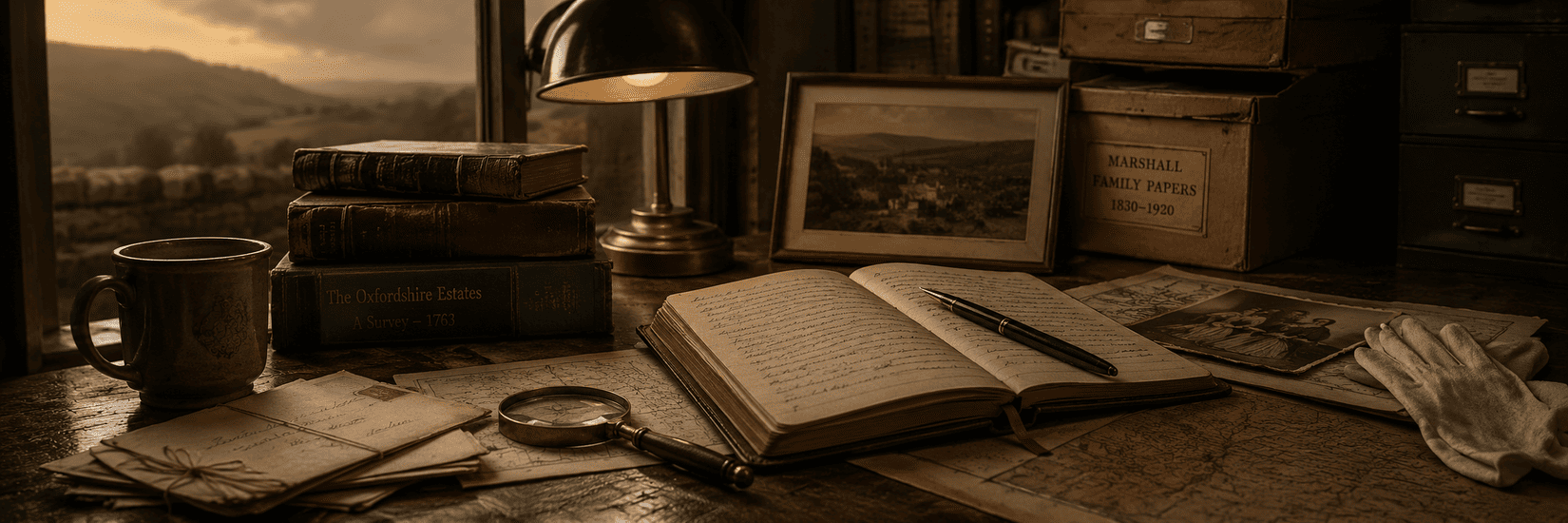
What Survives Unnoticed
There is a particular kind of evidence that rarely announces itself. It does not arrive in a sealed envelope or sit neatly inside a labelled file. It does not immediately answer the question that brought you looking in the first place. More often, it is something ordinary, such as a date written in the margin, a photograph placed among papers where it does not quite belong, or a name mentioned once and then never again.
The temptation is to pass over such things, but I have learned that doing so can be a mistake.
When we look into the past, there is an understandable desire to find the important pieces. We search for letters that explain what happened, photographs of significant occasions, and official records that provide names, dates and places. We imagine that the truth, if it has survived at all, will have had the good sense to make itself obvious.
It seldom does.
The past was once simply the present, and the people living through it had no way of knowing which moments would matter years later. They did not carefully preserve every conversation, disagreement or small kindness for the benefit of someone who might one day try to understand them. They kept what seemed worth keeping at the time, and sometimes they kept things for no particular reason at all.
That is why I have always been interested in what initially appears unimportant.
An old photograph may show the person you are searching for, but the more interesting detail might be the unfamiliar face standing at the edge of the frame. A letter may contain nothing remarkable until you notice that the return address is somewhere the writer was never supposed to have lived. A digital file may appear ordinary until you discover that it was created years before the other records surrounding it.
None of these details proves very much on its own, but evidence does not always begin with proof. Sometimes it begins with the quiet sense that something does not quite fit.
That feeling is easy to dismiss because we are accustomed to looking for certainty. We want facts that we can underline and conclusions that we can state without hesitation. Yet some of the most revealing discoveries begin with something much less impressive. They begin with a small detail that gives us a reason to look again.
I think the same is true when we try to understand a life.
We tend to remember the great events because they are easy to name. We remember births, marriages, deaths, journeys, successes and failures. Yet a life is not made from those events alone. It is also made from thousands of ordinary moments that nobody thought important enough to record.
Most of those moments disappear, but traces of some of them survive. A photograph remains in a drawer. A familiar name stays in an old address book. A note is found between the pages of a book. A forgotten file survives on a computer long after anyone remembers why it was created.
Occasionally, one of those small traces survives long enough for someone to notice that it was never as insignificant as it first appeared.
Perhaps that is why I have learned to be cautious with the word irrelevant. Something may appear irrelevant simply because nobody has yet thought to ask the question that gives it meaning.