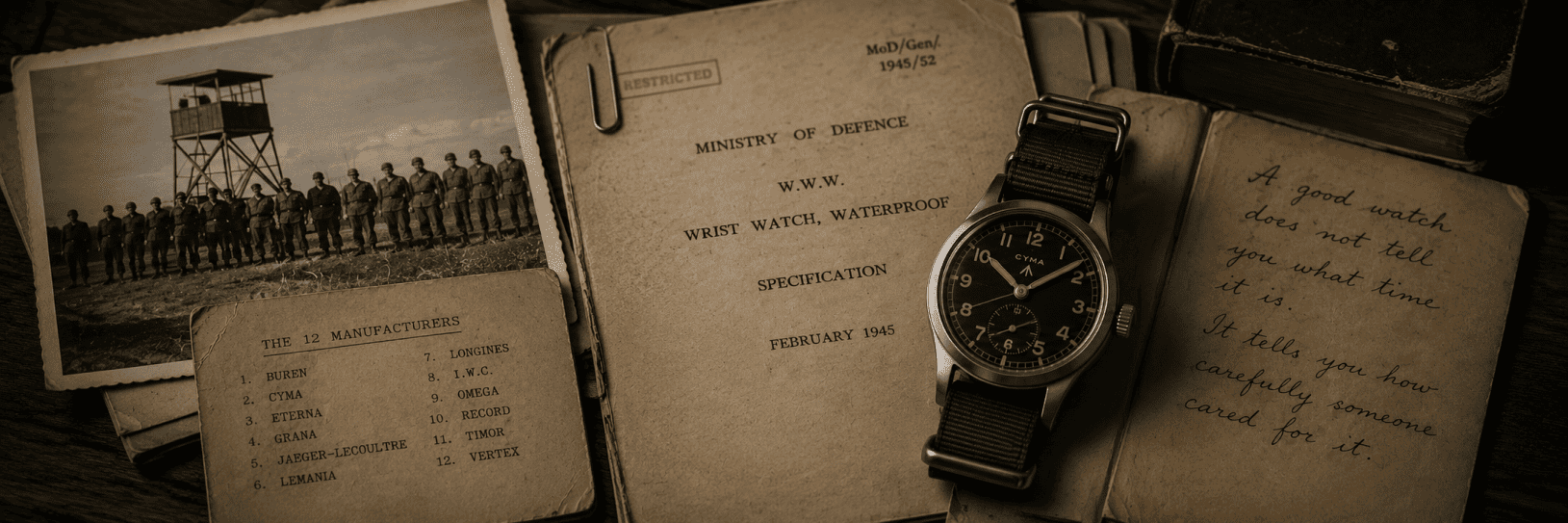
The Watch That Earned Its Reputation
Among collectors, they are known as the Dirty Dozen. The name came much later.
In 1945 they were simply twelve wristwatches produced for the British Ministry of Defence under a new military specification. The Army wanted a watch that was accurate, dependable, waterproof and easy to read in poor light. Earlier military watches had often been adapted from civilian designs. They had served their purpose, but the war had shown their limitations. The new specification demanded something built for military service from the beginning.
Twelve Swiss manufacturers were chosen to meet that standard.
Cyma was one of them.
I discovered that fact while researching an entirely different investigation. Had I been interested only in military history, I might have made a note of it and moved on. Instead I stopped reading and looked across the room.
A Cyma watch was resting on my desk. It had belonged to Tomasz Kovács.
Tomasz had carried it through the war, although it had begun its journey long before he put on a uniform. His father had been a watchmaker in Warsaw. Before Tomasz left home, his father placed the watch in his hand.
'It is not expensive,' he told him. 'It is reliable.'
Those words stayed with Tomasz for the rest of his life. When he spoke about his father, he never mentioned money or reputation. He spoke about workmanship. Every few years his father dismantled the watch completely, cleaned every wheel and pivot, examined every jewel for wear, applied fresh oil where it was needed and regulated the movement before putting it back together.
He believed a watch deserved to be cared for properly because one day somebody would depend upon it. Years later Tomasz repeated another lesson his father had taught him.
'A good watch does not tell you what time it is. It tells you how carefully someone cared for it.'
I have thought about those words often.
The Ministry of Defence eventually reached much the same conclusion, although by a different route. Engineers measured accuracy. Inspectors tested waterproof cases. Military trials examined reliability under demanding conditions. After months of testing, Cyma was judged to be one of only twelve manufacturers capable of meeting the Army's new standard.
The Ministry trusted the watch because it had passed every test. Tomasz's father trusted it because he had spent years repairing watches at his workbench. Those are not the same judgement.
One came from specifications and trials. The other came from experience.
I have always found the second judgement more persuasive. Perhaps that is because investigations have more in common with watchmaking than most people realise.
Evidence rarely arrives in perfect condition. Photographs fade. Letters lose pages. Official records contain mistakes. Magnetic tape deteriorates. Digital files become corrupted. Memories change each time they are recalled. Looking at any one piece in isolation tells you very little. Understanding comes from examining every surviving part carefully and discovering how those parts once worked together.
A watchmaker does much the same.
He cannot force a damaged watch to keep good time. He begins by understanding why it stopped. Every wheel has its purpose. Every pivot has its place. Nothing is ignored simply because it appears small. When each part has been cleaned, examined and returned to where it belongs, the movement begins to work again.
An investigation follows the same path.
The truth is rarely hidden in one dramatic discovery. More often it waits quietly inside a collection of ordinary things that have survived by chance, or because somebody cared enough to preserve them.
That may be why Tomasz's watch means more to me than the Ministry papers describing the Dirty Dozen. The watch explains why it had already earned the confidence of one watchmaker in Warsaw years before anyone in Whitehall wrote a specification.
History remembered the twelve manufacturers.
I prefer to remember the father who never needed a committee to recognise good workmanship.