The Places That Time Leaves Behind
There are places that disappear suddenly, but there are others that simply fade until almost nobody remembers that they were once filled with life. I have always found the second kind more interesting because their endings are rarely marked by a single event.
A forgotten village does not usually announce its final day. There is no morning when everyone closes their doors and agrees that the place has reached its end. Instead, one house becomes empty, then another. The shop closes because there are no longer enough customers. Children grow up and leave to find work elsewhere. An elderly neighbour dies, and nobody moves into the cottage afterwards. Gradually, the familiar sounds become fewer, and the village becomes quieter.
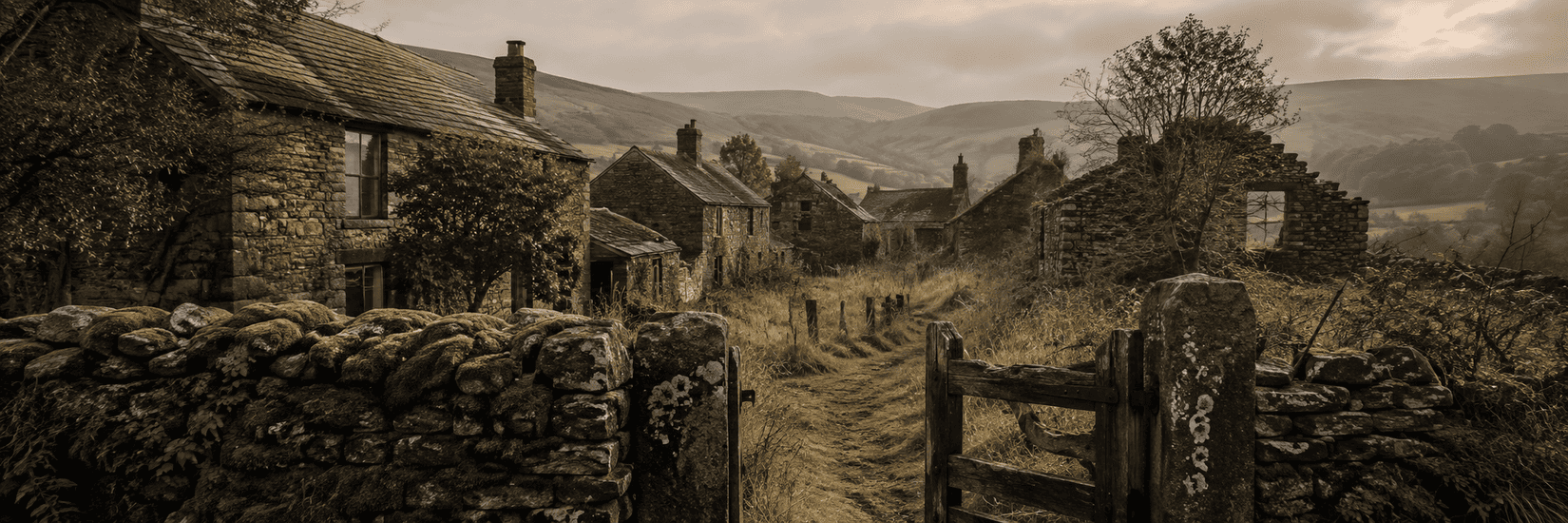
Years later, someone walking along an overgrown track might discover a broken wall beneath the brambles. An old gate may still hang from one hinge, opening onto a garden that has almost disappeared. A few fruit trees might continue to flower each spring, following a rhythm established when somebody still waited for the blossom and gathered the fruit in autumn.
The village itself has not entirely vanished. What has disappeared is the purpose that once gave all these things meaning.
We often think of history as something preserved deliberately in documents, photographs, museums and carefully labelled boxes. Yet much of the past survives for a simpler reason. Nobody has quite managed to remove all of it.
A worn doorstep can reveal where generations entered a house. A line of stones can show where someone once marked the edge of a garden. An unexpected patch of daffodils in an empty field may tell us that there was once a window nearby and that somebody cared enough about the view from it to plant flowers.
None of these things were intended to become evidence, which is precisely why I find them so valuable. They are the unplanned remains of ordinary lives.
It is worth imagining the village before silence took possession of it. Washing would have moved in the wind, smoke would have risen from chimneys, and somebody would have been repairing a fence that seemed certain to need repairing again next year. Children would have taken familiar shortcuts home. News would have travelled between neighbours at gates and doorways. Births, marriages, illnesses, arguments and deaths would have unfolded within a few hundred yards of one another.
The people who lived there would not have thought of these things as history. They were simply living their lives.
Perhaps that is what we forget when we visit abandoned places. We see ruins because we already know how the story ended, but the people who once lived among those walls had no such knowledge. They planted trees whose shade they expected to enjoy. They repaired roofs because they believed somebody would continue sleeping beneath them. They placed photographs in drawers and letters in cupboards because there seemed to be plenty of time to look at them again.
Then the world slowly changed around them. Roads moved elsewhere, work disappeared and families found reasons to leave. Houses emptied and familiar names gradually lost the people who remembered them. Eventually, a place that had existed entirely in the present became something described only in the past tense.
The landscape, however, does not forget quite so neatly. A path can remain slightly lower because thousands of footsteps once followed it. Nettles may grow where the soil was disturbed around a building. An old tree can continue standing in a field that was once somebody's garden.
Perhaps this is why forgotten villages affect us so deeply. They remind us that disappearance is rarely complete. People leave, buildings fall and names are forgotten, but traces usually remain.
An empty landscape may appear to contain very little. If we look carefully enough, however, we may discover that it is crowded with the remains of lives that once seemed every bit as permanent as our own.